Get approved for the drug company programs that give brand-name medicine at no cost
If you qualify, manufacturer patient assistance programs can ship your brand-name medicine to your door for $0, from insulin and inhalers to blood-sugar and heart medicines. The PAP Playbook is the exact step-by-step system a former patient advocate used to get families approved.
- Know in about 10 minutes whether you're likely to qualify
- Find the right program for each of your medicines
- Send an application that doesn't get sent back
- Turn a "no" into a "yes" with word-for-word letters and scripts
Instant download · One-time price · 30-day money-back guarantee
16 tools
The help is real. Getting it is the hard part.
Drug companies run programs that give their brand-name medicines away to people who qualify. But every program has its own rules, forms, income limits and deadlines, and one missing signature can stall an application for weeks. So people who could qualify end up doing one of three things:
Going without
Skipping doses, stretching refills, or choosing between a prescription and groceries, while a program they qualify for is one application away.
Paying monthly for help
Advocacy services often charge every month to fill out applications the drug companies give away for free.
Giving up after a "no"
Most denials aren't final. They're fixable: missing income proof, an unsigned page, or a doctor's office that never sent its part.
Three ways to go after help. Only one keeps you in control.
| On your own | Monthly service | The PAP Playbook | |
|---|---|---|---|
| Cost | Free, but costs you hours | About $100 every month | $47 once |
| Which program fits you | Guesswork | They decide | Step-by-step test + directory |
| Complete application | Easy to miss things | They fill it out | Checklists for your exact situation |
| If you're denied | Often the end | Depends on the service | 14 fixes + appeal letters |
| Every year after | Start over | Keep paying | Re-enrollment calendar |
What manufacturer programs charge to apply, enroll, or ship your medicine.
One approved brand-name prescription can be worth far more than this guide costs.
One time, for the full system, all 16 tools, and every page you'll ever need to reprint.
Insulin, inhalers, and other high-cost medicines
Without good coverage, a single brand-name prescription can cost hundreds of dollars a month. These are some of the medicines covered in the playbook's directory, and what to know about each group.
Insulin
Humalog · Humulin · Basaglar · Lyumjev · NovoLog · Tresiba · Fiasp · Lantus · Toujeo
Lilly Cares and Novo Nordisk accept people up to 400% of the poverty level (about $63,840 for one person in 2026). On Medicare? Your Part D insulin copay is capped at $35 a month.
COPD & asthma inhalers
Spiriva · Stiolto · Combivent · Breztri · Airsupra · Bevespi · Trelegy · Breo · Anoro
Three different makers, three different sets of rules. Some programs want proof of what you've already spent this year if you're on Medicare. The playbook shows you which.
Blood-sugar medicines
Jardiance · Glyxambi · Tradjenta · Januvia · Janumet · Trulicity
Each one belongs to a different program with its own income limit. Note: Ozempic has much stricter rules (uninsured and under 200% of the poverty level only).
Blood thinners & heart medicines
Eliquis · Xarelto · Entresto · Verquvo · Tikosyn
Some of these programs ask Medicare patients to show they've spent a share of their income on prescriptions first. For BMS (Eliquis), it's 3% of household income this calendar year.
ADHD medicines
Brand-name and extended-release ADHD medicines
Many common ADHD medicines, like Adderall and Vyvanse, now come as lower-cost generics, which manufacturer programs usually don't cover. For brand-only ADHD medicines, the playbook shows you how to find the maker's program in minutes, and Plan B covers other ways to cut the cost.
Migraine medicines
Nurtec · Emgality · Ajovy
Three makers (Pfizer, Lilly, and Teva), each with its own program, income limit, and way to apply.
Arthritis, psoriasis & eczema
Taltz · Olumiant · Ebglyss · Cibinqo · Eucrisa · Humira · Skyrizi · Rinvoq
Specialty medicines often have higher income limits. Lilly allows up to 500% of the poverty level for Taltz and Olumiant.
Mental health & movement disorders
Rexulti · Abilify Maintena · Austedo · Uzedy
Covered by the Otsuka and Teva programs. Teva Cares accepts people up to 300% of the poverty level and usually responds within 2 to 3 business days.
Coverage and rules change. The playbook marks which programs were confirmed on their official sites in November 2026 and which to confirm by phone. Brand names are trademarks of their owners; we're not affiliated with any manufacturer.
What you'll know that most people don't
- The four tests every program uses, and how to check all four in about 10 minutes.
- The "150% line" that changes what many programs ask Medicare patients to do first.
- How to qualify when you're a little over the income limit: the household and income rules most people get wrong.
- Why the "donut hole" advice you've heard is out of date, and what the 2026 Medicare rules mean for you.
- Which programs want proof of what you've spent this year, and how to prove it with one pharmacy printout.
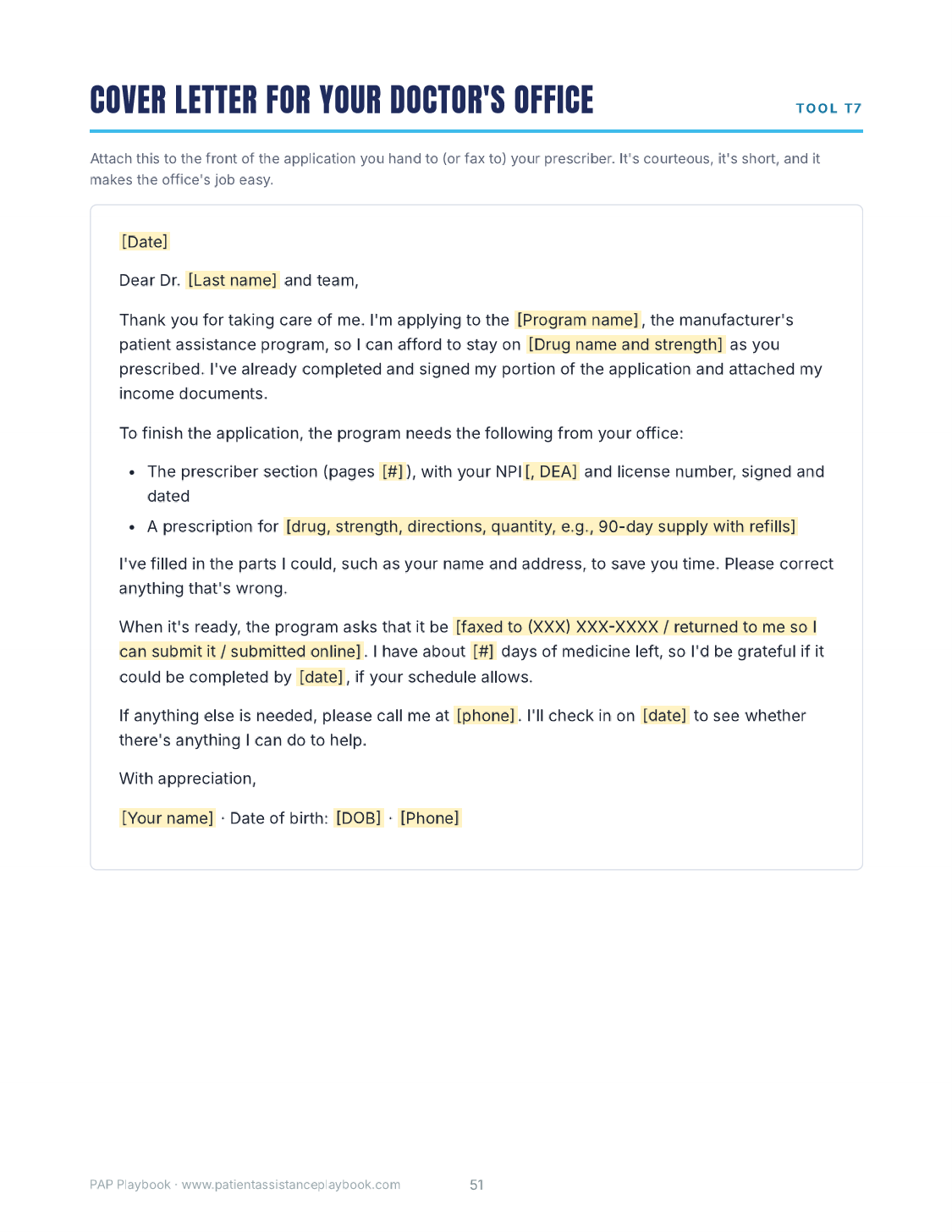
- The cover letter that gets busy doctors' offices to send their part, without telling the doctor how to do their job.
- The 14 most common denial reasons and the exact fix for each one.
- Word-for-word phone scripts for doctor's offices and program staff.
- The two-thirds refill rule that keeps medicine arriving with no gaps.
- When to re-apply each fall so January doesn't leave you without medicine.
Nobody should have to pay every month for access to medicine they already qualify for, or go without because nobody explained the rules.
Tom A.
Written by someone who did this for a living
For years, Tom A. ran a patient advocacy service. Families paid every month for help finding the right manufacturer program, filling out the paperwork, following up with the doctor's office, and pushing back on denials. Tom did the same for family and friends, and watched people go from rationing pills to having their medicine delivered to their door.
The work also showed two things that were hard to ignore: people being taken advantage of by paid services, and people going without their medicine because nobody told them these programs existed.
So Tom stepped away from the monthly model and put the whole system into one playbook you can follow yourself, at your own pace, as many times as you need.
Everything from "Do I qualify?" to "I'm approved"
61 pages in plain language, plus 16 print-ready tools.
Find out if you qualify
The four tests, the 2026 income table, and five insurance tracks: uninsured, private insurance, Medicare Part D, Part D with high drug costs, and Medicaid.
Apply the right way
Build a complete application, get your doctor's office to cooperate, submit it, and track it until you have a decision.
Denials and appeals
The 14 most common denial reasons with fixes, reconsideration, hardship requests, and Medicare and insurance appeals.
Stay enrolled
The yearly re-enrollment cycle, Medicare deadlines, and the refill routine that keeps medicine arriving.
Free tools and program directory
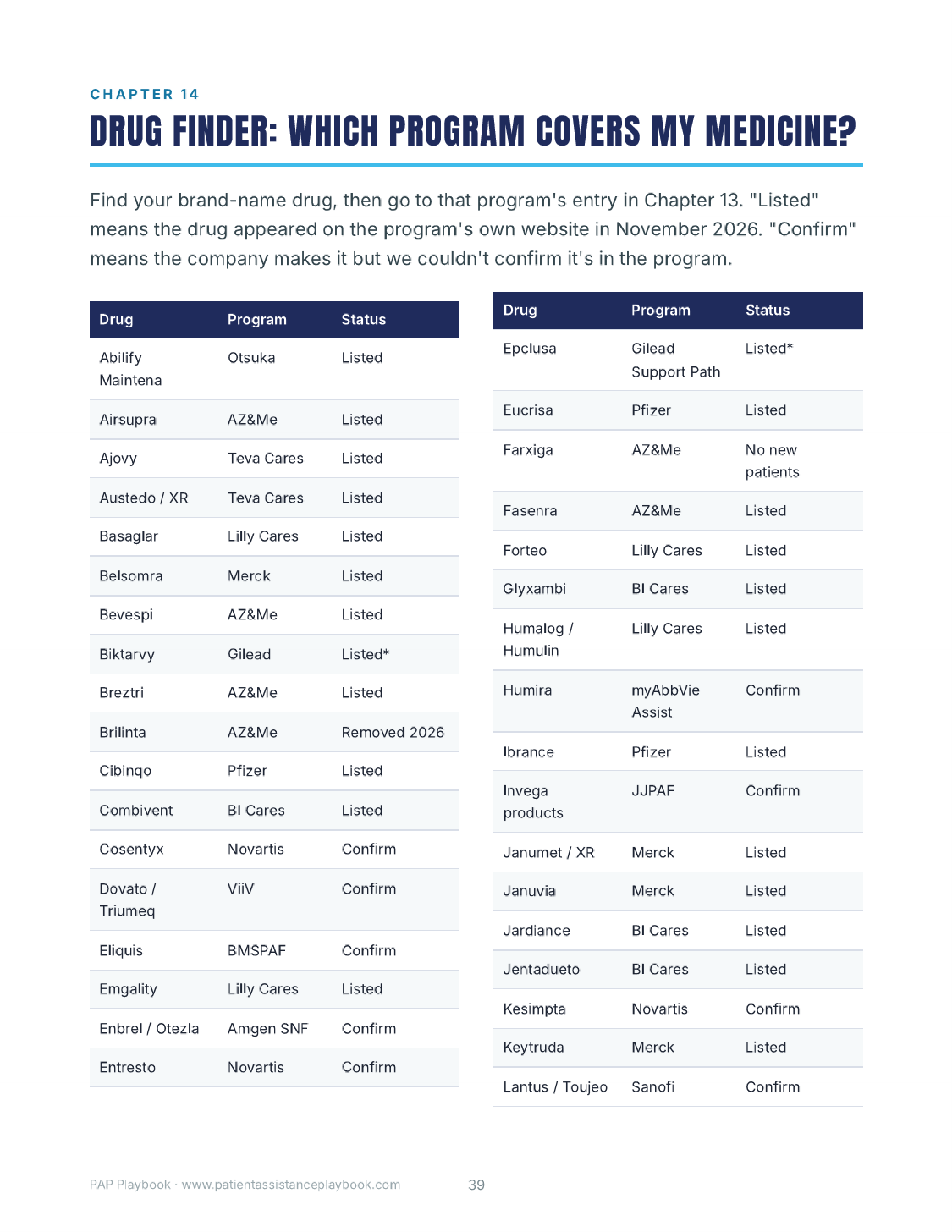
Free search tools and help services, 18 manufacturer programs, and a drug finder covering about 70 brand-name medicines.
Plan B
Don't qualify? Extra Help, Medicare Savings Programs, charitable copay foundations, health centers, and more.
16 done-for-you tools
- 5 master checklists, one for each insurance track
- Income worksheet with the federal poverty table
- Cover letter for your doctor's office
- Reconsideration (appeal) letter
- Income-change and zero-income letters
- Request for a doctor's letter of support
- Application tracker and refill log
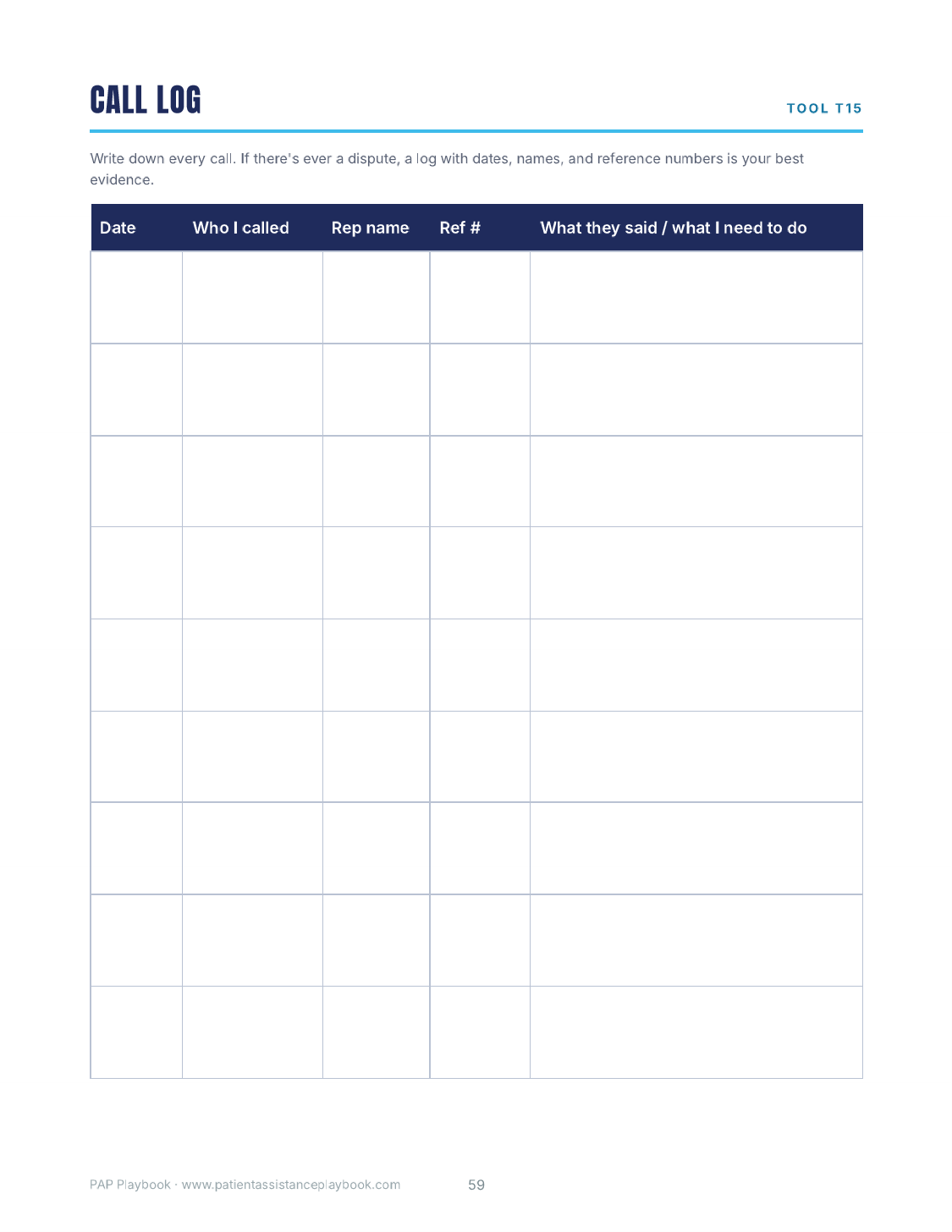
- Call log and re-enrollment calendar
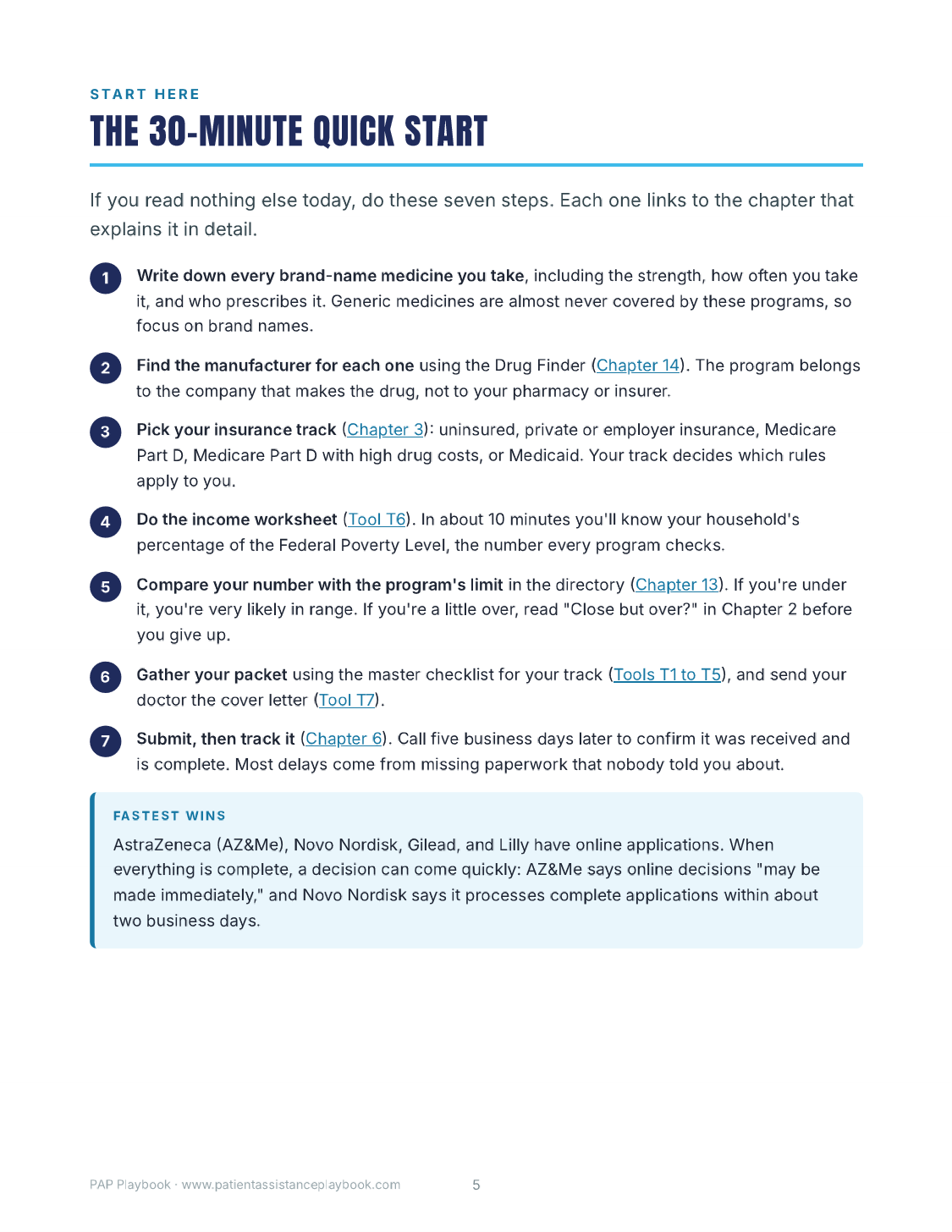
Every form prints on its own page, with large writing spaces that are easy to fill in and read.
Clear pages you can actually use
Who this playbook is for
A great fit if you…
- Take one or more expensive brand-name medicines
- Are uninsured, or on Medicare Part D and struggling with costs
- Are helping a parent, spouse, or relative with their prescriptions
- Want to do it yourself instead of paying a monthly service
- Were denied before and want to know why
Probably not for you if…
- All your medicines are generics (these programs cover brand names)
- You have Medicaid with low copays already
- Your household income is well above 500% of the poverty level
- You want someone else to apply for you
Less than half of one month of a paid service
Pay once. Keep it. Use it every year, for yourself and the people you care for.
- The Patient Assistance Playbook, 2026 Edition (61 pages)
- Directory of 18 manufacturer programs + drug finder for about 70 medicines
- 16 print-ready tools: checklists, worksheets, letters, trackers, and logs
- Step-by-step denial and appeal playbook with letter templates
- Word-for-word phone scripts for doctors' offices and programs
- Free tools and help services list, plus Plan B options
- Read on any phone, tablet, or computer; print as many copies as your household needs
Secure checkout. Your download link arrives by email right away.
Try it risk-free. If the playbook isn't helpful, email us within 30 days for a full refund. No forms, no hassle. Refund policy
Helping several patients, a church, or a senior center? Email patientassistanceplaybook@gmail.com about an organization license.
Get the free "Do I Qualify?" checklist
A one-page checklist with the four tests every program uses and the 2026 income table, so you can see in five minutes whether it's worth applying.
Send Me the Free Checklist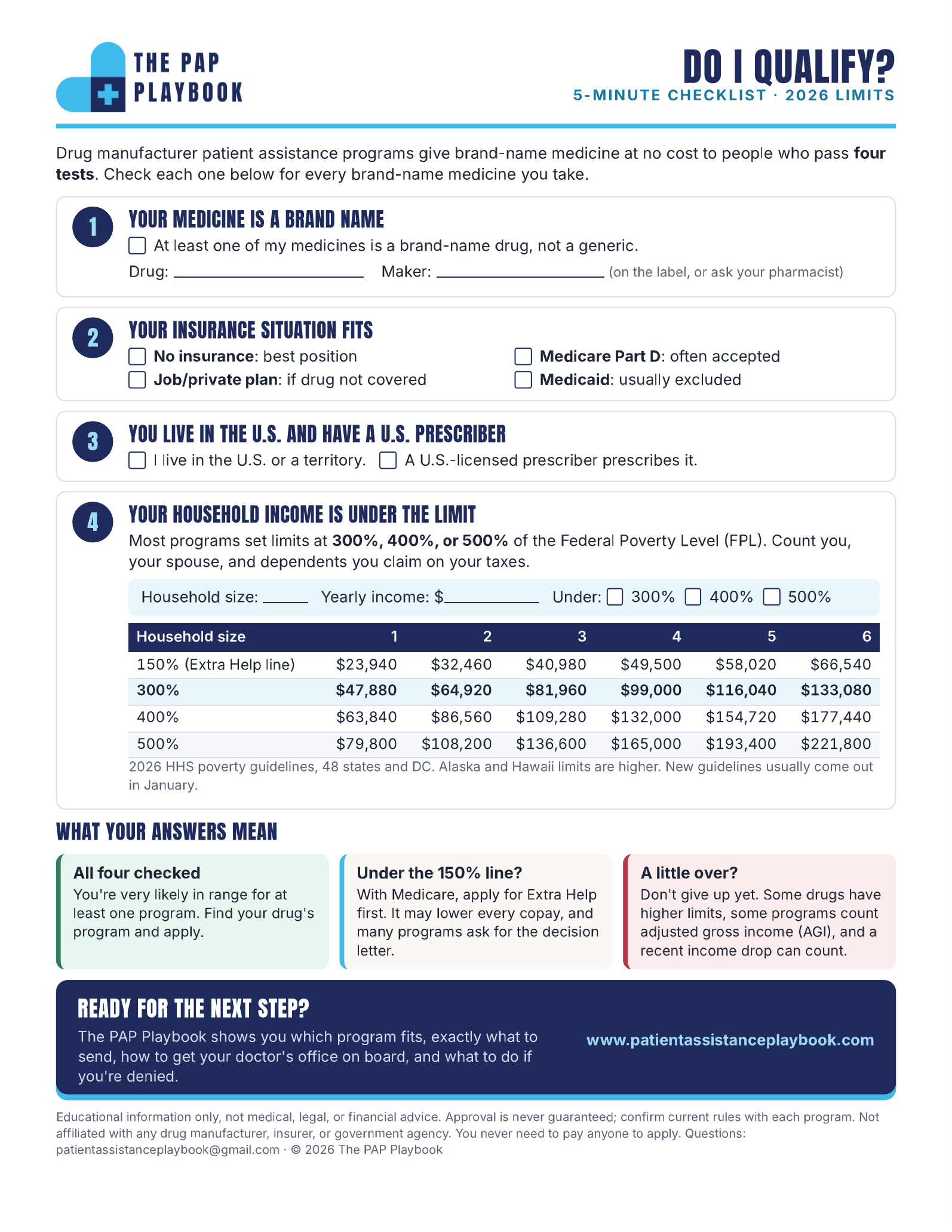
Frequently asked questions
Isn't this information available for free?
Yes. The programs are free, and tools like NeedyMeds and RxAssist list them at no cost. The playbook even includes a chapter on those free tools. What it adds is the method: which program fits your insurance situation, exactly what to send, how to get your doctor's office to do its part, how to fix a denial, and how to stay enrolled year after year, with templates for each step.
Will this get me free medication?
It depends on whether you meet a program's rules, mainly household income and insurance. No one can guarantee approval, because each program makes its own decisions. The playbook helps you find out quickly whether you qualify and gives you the best chance of being approved if you do.
I have Medicare. Can this help me?
Often, yes. Many programs accept people with Medicare Part D who meet their income limits, sometimes with extra requirements such as proof of what you've spent this year. The playbook has a full chapter on Medicare, including Extra Help and the yearly out-of-pocket cap.
I have insurance through my job. Does this apply to me?
Most manufacturer programs don't accept people with private insurance, but there are exceptions, such as when your plan doesn't cover the drug at all. The playbook explains those exceptions, copay cards, and how to appeal an insurance denial.
Is my medicine covered?
The drug finder covers about 70 commonly prescribed brand-name medicines across 18 manufacturer programs, including drugs for diabetes, blood clots, COPD and asthma, heart failure, migraine, arthritis and psoriasis, and some cancers. If yours isn't listed, the playbook shows you how to find its program in minutes.
Do I need to be good with computers?
No. Many programs accept paper applications by fax or mail, and every checklist, letter, and tracker in the playbook prints on its own page with large writing spaces. Many buyers are caregivers who print it for a parent.
How do I get it after I buy?
Right after checkout you'll get an email with your download link. The PDF opens on any phone, tablet, or computer, and you can print it.
What if programs change?
They do, every year. Every program entry shows how it was checked in November 2026, and the playbook tells you how to confirm current rules before you apply. A yearly Annual Update Edition is available for past buyers.
Are you affiliated with any drug company or with Medicare?
No. The PAP Playbook is independent. We aren't affiliated with any drug manufacturer, foundation, insurer, or government agency, and we don't apply on anyone's behalf.